Inflatable life jackets (inflatable PFDs – Personal Flotation Devices) are a fundamental component of yacht safety equipment. Widely used in recreational boating, offshore sailing and professional yacht operations, they provide reliable buoyancy in the event of accidental immersion while ensuring superior comfort compared to traditional foam life jackets.
However, the performance of an inflatable life jacket depends entirely on correct selection, proper wearing and systematic maintenance. This technical guide outlines best practices for inspection, activation, storage and servicing in line with international maritime safety standards such as ISO 12402 and SOLAS (where applicable).
What Is an Inflatable Life Jacket?
An inflatable life jacket is a personal flotation device that remains compact until activated. When triggered, a CO₂ cylinder inflates an internal air bladder that provides buoyancy and helps maintain the wearer’s airway above water.
Compared to foam PFDs, inflatable models offer:
-
Reduced bulk and improved mobility
-
Increased comfort for prolonged onboard wear
-
Suitability for watchkeeping and deck operations
-
Compatibility with professional yacht safety programs
For yacht environments, inflatable PFDs are often preferred due to operational practicality and ergonomic design.
Types of Inflatable Life Jackets for Yacht Operations.
Choosing the correct type of inflatable life jacket depends on operating area, crew competence and risk assessment.
Manual Inflation Life Jackets.
Manual inflatable life jackets require the wearer to pull an activation cord. The CO₂ cylinder is pierced only when manually triggered.
Recommended for:
-
Controlled environments
-
Competent swimmers
-
Low-risk onboard operations
Limitation: Requires conscious activation.
Automatic Inflation Life Jackets.
Automatic inflatable life jackets inflate upon water immersion. Activation systems typically include:
-
Dissolvable tablet mechanisms
-
Hydrostatic release mechanisms
Recommended for:
-
Offshore navigation
-
Rough-weather operations
-
Night watches
-
Reduced-mobility scenarios
These models provide an additional safety margin when immediate manual activation may not be possible.
Dual Inflation Systems (Automatic + Manual).
Dual-system inflatable life jackets combine automatic activation with a manual backup pull cord. Many models also include an oral inflation tube for topping up air.
For most yacht safety programs, dual systems represent the preferred configuration due to redundancy and operational flexibility.
Pre-Use Inspection Checklist for Inflatable PFDs.
Routine inspection is critical to ensure reliability. A pre-use safety check should always be conducted before departure.
Visual Inspection.
Examine the outer cover and structural components:
-
No tears or abrasions
-
No UV degradation
-
Intact stitching
-
Functional buckles and straps
-
Cover properly closed
Damage to the outer shell may compromise inflation performance.
CO₂ Cylinder Verification.
Confirm that:
-
The cylinder is properly screwed in
-
It has not been pierced
-
It shows no corrosion
-
It matches manufacturer specifications
-
The status indicator shows green (armed and ready)
Improper cylinder installation is one of the most common causes of deployment failure.
Automatic System and Expiry Dates.
For automatic inflatable life jackets:
-
Verify cartridge or tablet expiry date
-
Check hydrostatic release date (if installed)
-
Ensure manual pull tab is fully accessible
Expired components must be replaced immediately.
Annual Leak Test.
At least once per year:
-
Inflate the bladder orally
-
Leave it pressurized for 12–24 hours
-
Confirm there is no pressure loss
Any drop in pressure indicates internal leakage and requires servicing before operational use.
How to Wear an Inflatable Life Jacket Correctly.
Correct fitting significantly influences flotation performance.
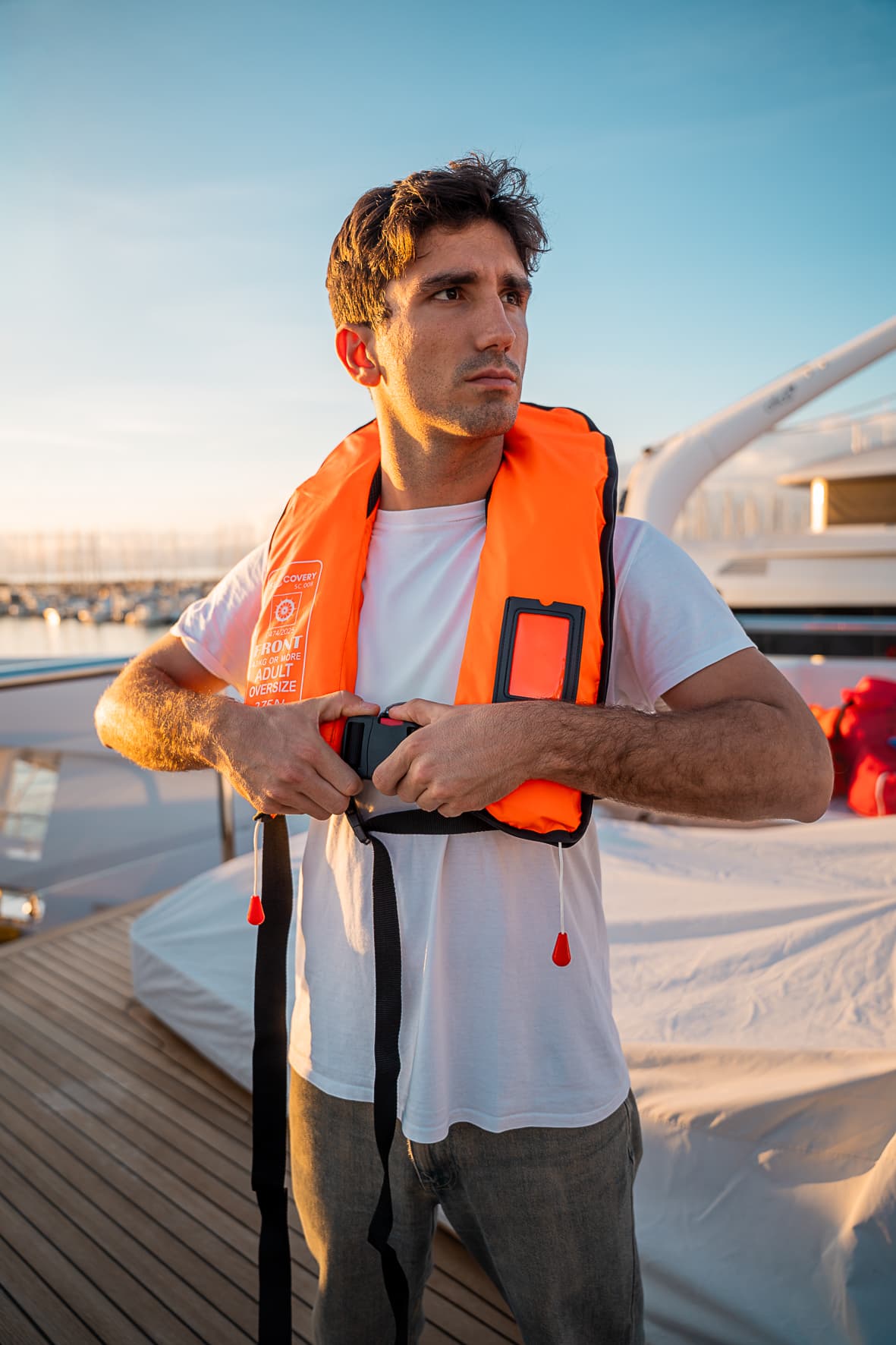
Proper wearing procedure:
-
Always wear over clothing
-
Tighten waist belt securely
-
Secure crotch or thigh straps (if equipped)
-
Ensure the jacket does not ride up when lifted at the shoulders
The bladder must sit flat against the chest. No equipment, tools or harness hardware should obstruct inflation zones.
When integrated with yacht safety harness systems, confirm compatibility and unrestricted deployment.
Inflatable Life Jacket Activation Procedures.
Understanding activation procedures increases response effectiveness during emergency situations.
Automatic Activation
Upon water immersion, the device inflates automatically. During inflation:
-
Remain calm
-
Keep airway clear
-
Avoid compressing the bladder
Allow full inflation before adjusting position.
Manual Activation
Pull the activation cord sharply downward. Verify full inflation. If partial inflation occurs, use the oral tube to supplement air.
Oral Inflation
The oral tube allows additional air to be added manually. After use, ensure the valve is securely closed to prevent leakage.
Post-Deployment and Water Exposure Procedure.
After immersion or activation:
-
Rinse thoroughly with fresh water
-
Dry completely in a ventilated area
-
Replace used CO₂ cylinder
-
Replace automatic cartridge if activated
-
Repack according to manufacturer instructions
Never store an inflatable life jacket while damp, as moisture can accelerate corrosion and degrade internal components.
Storage and Maintenance Best Practices.
Proper storage extends equipment lifespan and ensures operational readiness.
Recommended conditions:
-
Cool, dry environment
-
Protection from prolonged UV exposure
-
Avoid excessive compression
-
Keep away from fuels, solvents and chemicals
Maintenance schedule for yacht safety programs:
-
Before each use: visual + indicator check
-
Every 2–3 months: full inspection
-
Annually: leak test and service
-
After activation: full rearming
For offshore and commercial yacht operations, annual professional servicing is strongly recommended.
Operational Limitations and Safety Considerations
Inflatable life jackets:
-
May not be suitable for non-swimmers unless automatic
-
Are generally not recommended for high-impact water sports
-
Must not be modified or repaired without manufacturer approval
-
Must be compatible with onboard PPE and harness systems
Risk assessment should always determine the appropriate model and buoyancy rating.
Inflatable life jackets provide high comfort and reliable buoyancy, making them ideal for yacht safety environments. However, reliability depends on systematic inspection, correct wearing procedures and scheduled maintenance.
In yacht operations, safety begins before departure. Equipment readiness, crew familiarity and structured maintenance protocols are essential to ensure effective personal flotation protection at sea.